Sensor solutions for stacker cranes
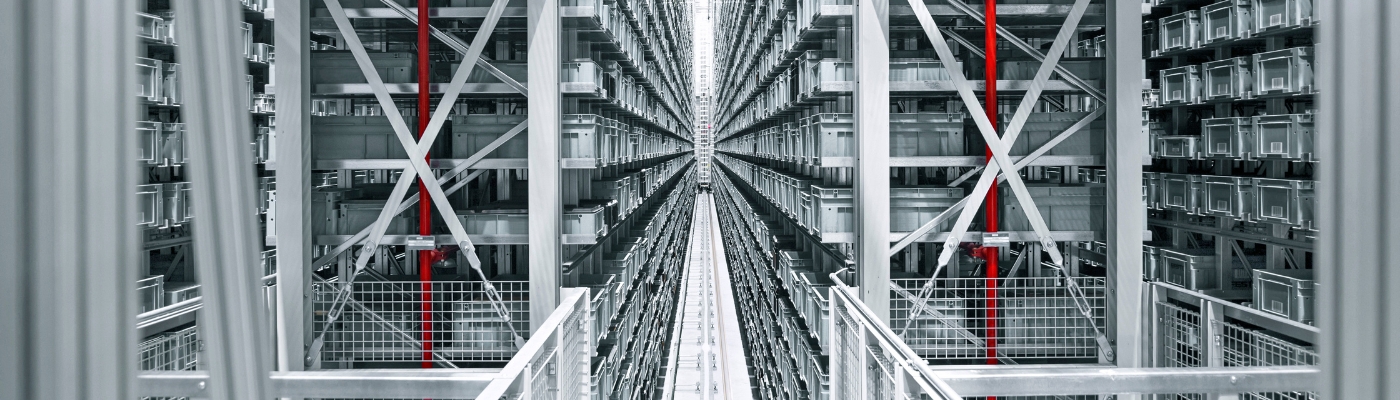
Stacker cranes take over the automated storage and retrieval of goods in high-bay warehouses. Their speed and reliability – even under demanding conditions such as low temperatures – are crucial to the system’s overall performance and availability.
As rail-guided vehicles equipped with a lifting device and load receptacles, such as a telescopic fork, stacker cranes move pallets or containers to the designated shelves and retrieve them as needed.
Sensor applications on stacker cranes
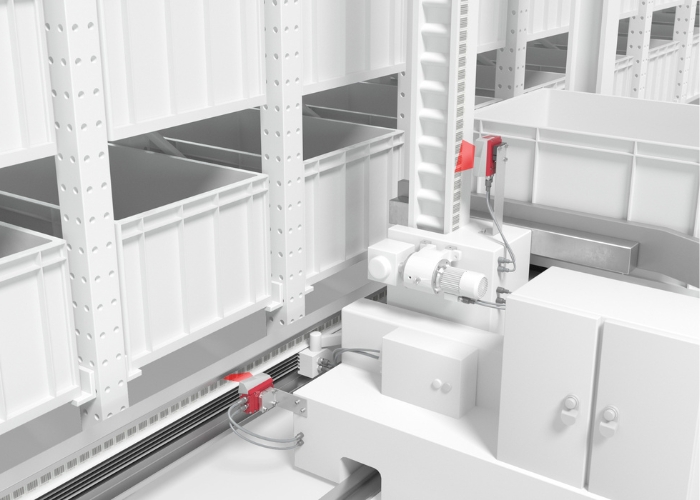
Stacker cranes require numerous sensor applications to ensure reliable and efficient operation. The simple alignment and adjustment of sensors from Leuze enable quick and trouble-free commissioning. During operation, the sensor solutions support the precise control and monitoring of movements, thereby helping to optimize storage and retrieval processes and increase handling capacity. In addition, optical compartment occupancy checks and push-through protection reliably protect the stored goods and the system’s mechanical components from damage.
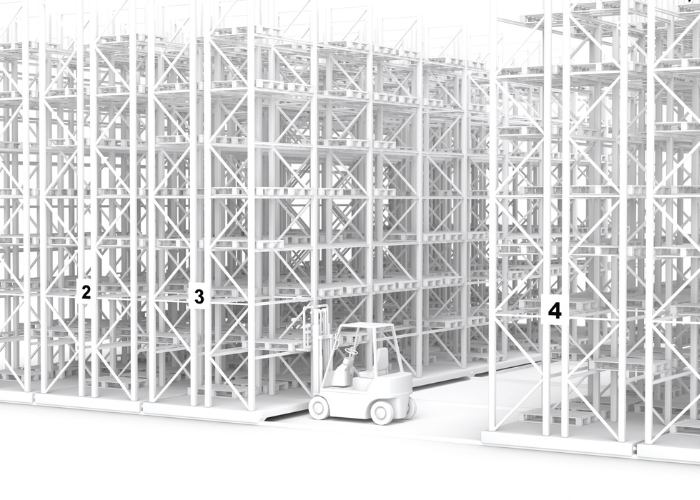
Click on the numbered applications to learn more about the respective sensor solutions.

Sensor solutions for stacker crane positioning, detection, and data transmission
There are various key sensor technology applications to support the automated operation of stacker cranes. These range from the positioning and fine-positioning of the vehicle and the load receptacle, through the detection of load carriers, final positions, and compartment occupancy, to optical data transmission from the stationary control system to the moving stacker crane.
Applications for positioning stacker cranes
Positioning with bar code positioning system
Requirement:
The stacker crane or load receptacle must be positioned in the X-direction (travel axis) and Y-direction (lifting axis) accordingly for the position to be approached.
Solution:
The compact BPS 300i bar code positioning systems enable exact positioning. Interfaces for fieldbuses, industrial Ethernet as well as SSI or serial connections make integration in the control simple and flexible. The configuration and diagnosis of the devices are just as easy.
Safe positioning with bar code positioning system
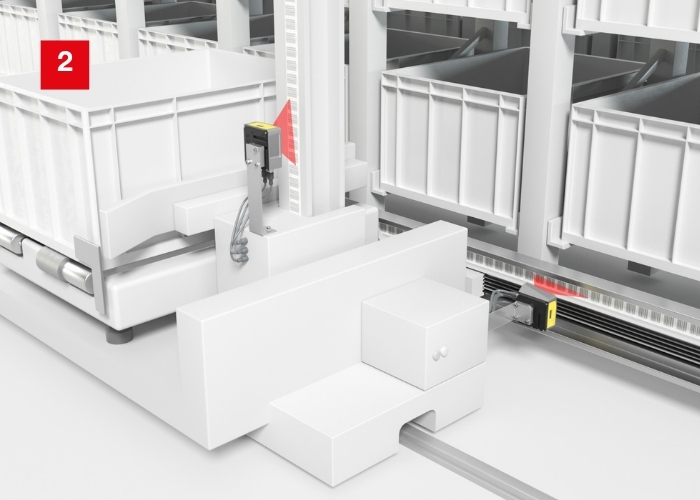
Requirement:
The stacker crane or load receptacle must be positioned in the X-direction (travel axis) and Y-direction (lifting axis) accordingly for the position to be approached. Often the risk assessment requires safe position and velocity monitoring. For this purpose, safe position detection is necessary.
Solution:
The FBPS 600i safe bar code positioning system requires just one sensor for safe position detection. The device is connected via two SSI interfaces or a PROFIsafe interface to a safe evaluation unit – e.g. a frequency inverter – or safe PLC and is suitable for applications up to PL e. This makes it easy to implement safety functions.
Positioning with laser positioning system
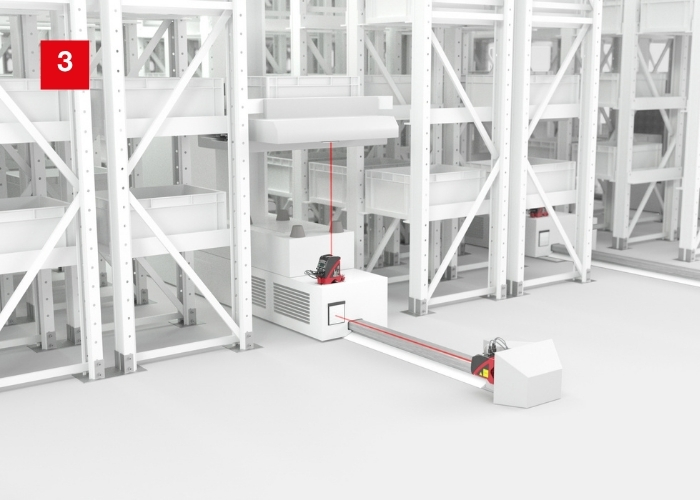
Requirement:
In a high-bay warehouse with an aisle length of 120 m, load carriers (boxes, cartons and pallets) are to be stored and retrieved using a stacker crane. Automation and control must be controlled by a sensor and actuator system. Mechanical distance sensors, which are subject to wear or prone to contouring errors, are not to be used.
Solution:
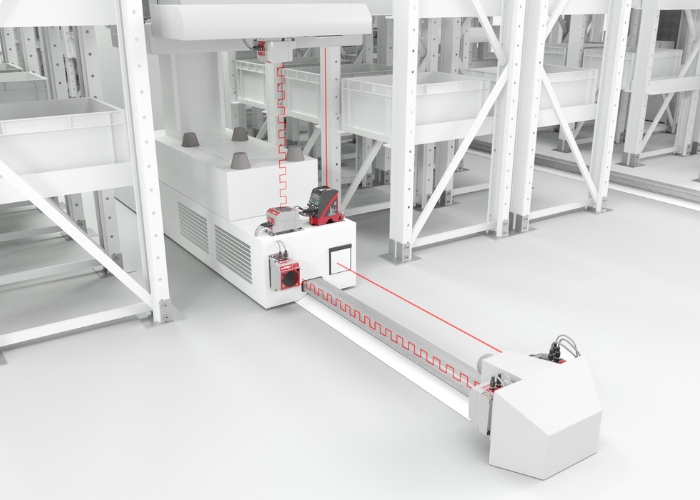
The position of the stacker crane can be ascertained by means of an optical system which determines the distance between the vehicle and the end of the aisle. The AMS 100i optical position sensor reliably performs tasks up to 200 m (AMS 300i up to 300 m) and offers a traverse rate of up to 10 m/s as well as an accuracy of +/- 2 mm. And, unlike mechanical systems, it is absolutely free from wear.
Compartment fine positioning (single-depth)
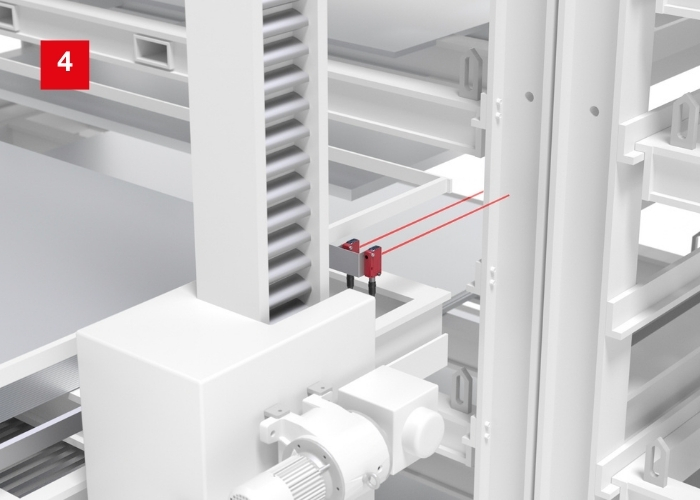
Requirement:
After the rough positioning of the stacker crane, the compartment fine positioning must take place in the horizontal (X) and vertical (Y) direction. To do this, the edges of the transoms and uprights must be optically scanned at a distance of 100 to 600 mm.
Solution:
The HT 25C and HT 46C diffuse reflection sensors with background suppression are used for positioning the load receptacle. A wide variety of profile types, as well as colored and shiny surfaces, are reliably detected. Thanks to the optimized beam path, the sensors function reliably even in the case of columns with holes.
> Read more about diffuse sensors with background suppression
Compartment fine positioning with optical sensor (single-depth and double-depth)
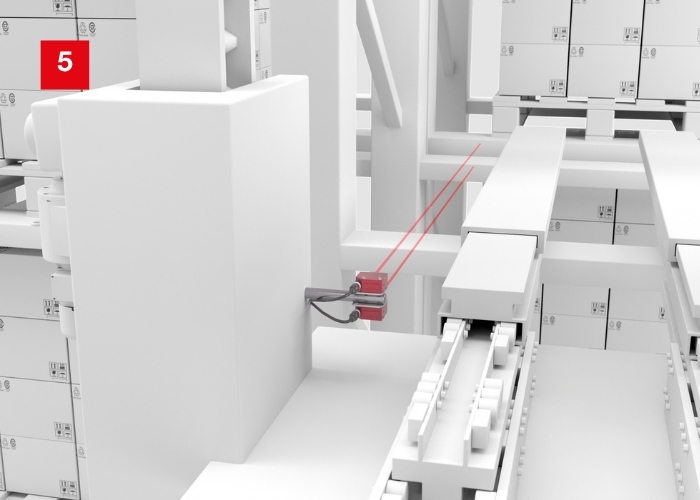
Requirement:
After the rough positioning of the stacker crane, the compartment fine positioning must take place in the horizontal (X) and vertical (Y) direction. To do this, the edges of the transoms and uprights must be optically scanned at a distance of 100 to 1,900 mm.
Solution:
The HT 110 series diffuse sensors reliably detect different materials even under changeable conditions. They are characterized by precise switching behavior at profile edges. With their operating range of up to 5,000 mm, they are also suitable for use in double-depth storage locations.
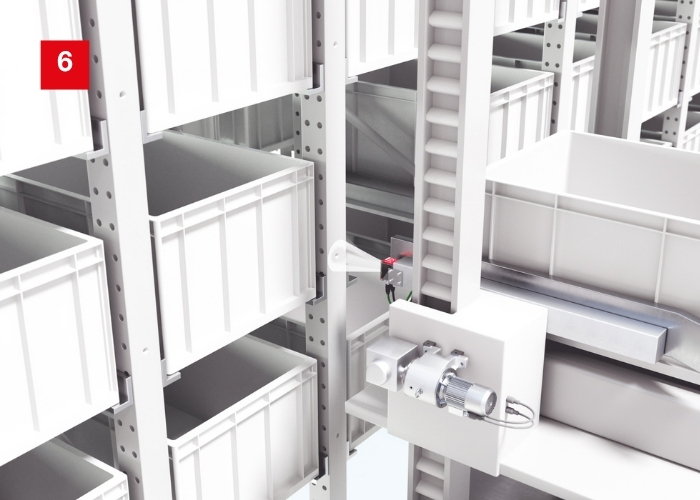
Compartment fine positioning with camera-based sensor (single-depth and double-depth)
Requirement:
After the rough positioning of the stacker crane, the compartment fine positioning must take place in the horizontal (X) and vertical (Y) direction. For this purpose, the bar or column markings are to be sensed by a camera at a distance of 100 to 1,900 mm.
Solution:
The compact IPS 200i / 400i camera-based sensors are used for compartment fine positioning in front of single-depth or double-depth shelves. Via the integrated Ethernet TCP/IP, PROFINET or Ethernet/IP interface, the devices can be easily integrated into different controls and easily configured via the integrated web server.
Detection applications on stacker cranes
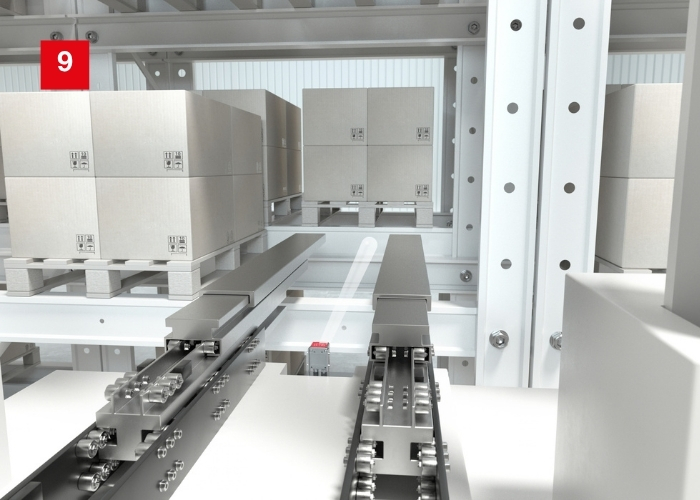
Compartment occupation check / push-through protection
Requirement:
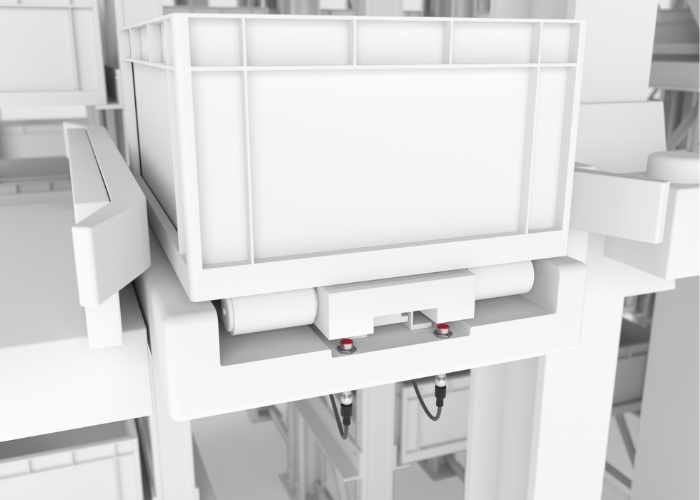
Before a pallet or cassette can be stored on a shelf, it must be checked that the shelf is empty. During retrieval, the stored material must be monitored to ensure it is not pushed through when the telescopic arm or fork is moved.
Solution:
TheHRT 25B Long Range and ODS 110 sensors with measurement value or switching output as the HT 110 use a focused laser to detect goods at an operating range of up to five meters, providing a high function reserve. With switching product models, the movement of the cassette can be detected with the help of the window function.
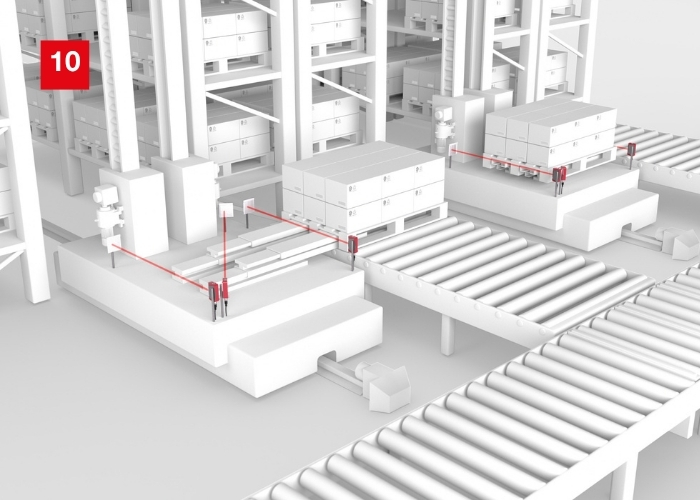
Presence control
Requirement:
After storage or retrieval, a check must be performed to ensure that the load receptacle has completely unloaded or pulled in the material to avoid collisions and downtime.
Solution:
The optical sensors of the 3C, 25C and 46C series are characterized not only by their long operating range and increased function reserve, but also by their easy handling. With their different optics models, the devices ensure reliable object detection – e.g. even with shrink-wrapped or perforated packages.
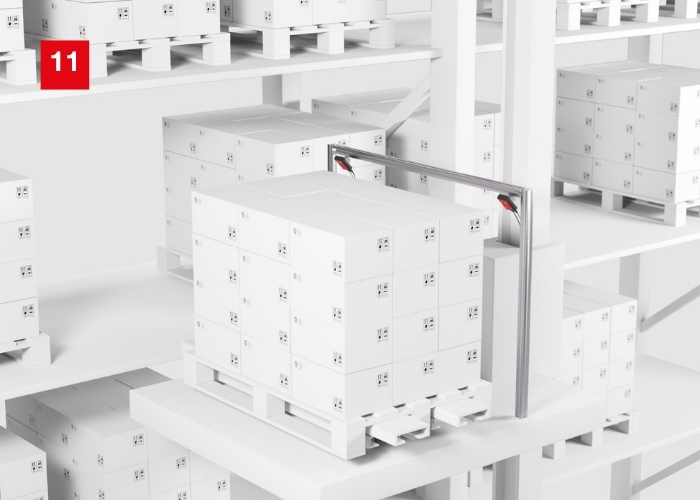
Visual monitoring
Requirement:
A camera installed on-site is used for remote visual diagnosis of the stacker crane and its load receptacle. It allows the relevant components to be inspected remotely, without the need to be physically present in the warehouse.
Solution:
The industrial IP camera LCAM 308 offers insights into areas which are not accessible by system operators. This simplifies troubleshooting in case of failure. The robust camera delivers live streams at high image quality due to its Ethernet interface. In addition, the recording of the last minute can be retrieved.
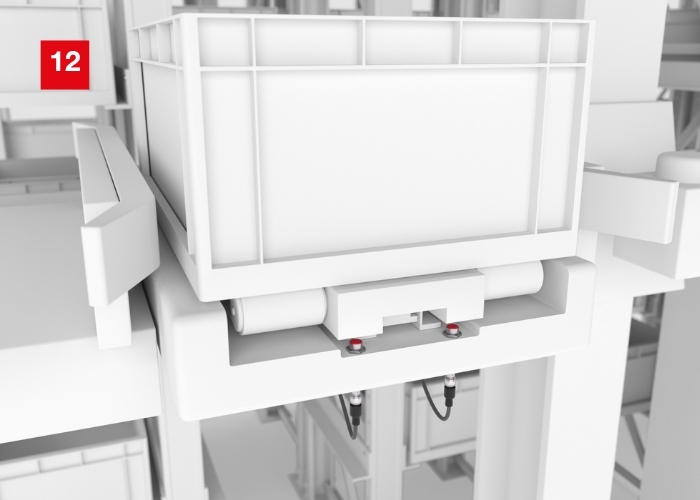
Detection of the final position of the load receptacle
Requirement:
Before the stacker crane is allowed to move, it must be checked whether the load receptacle is in the final position.
Solution:
The inductive sensors of the IS 208 and IS 212 series reliably detect metal objects. The devices with robust metal housing can be optimally adapted to the respective application by selecting the switching output, the connection and the operating range.
Applications for optical data transmission
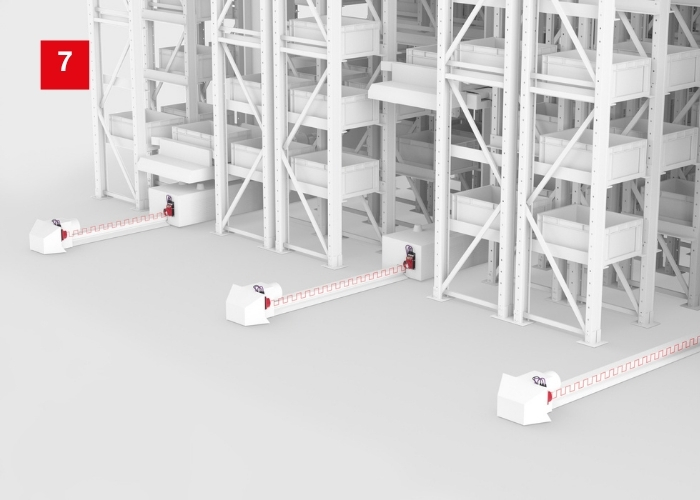
Optical data transmission up to 2 Mbit/s
Requirement:
Data is to be transmitted wirelessly from fieldbuses such as PROFIBUS, CANopen and Interbus to the stacker crane or the load receptacle. The transmission rate must be up to 2 Mbit/s.
Solution:
The DDSL 200 data transmission photoelectric sensor is available with all common industrial fieldbus interfaces and is therefore easy to integrate into the system. Different operating range models from 80 to 500 m always offer a tailor-made solution.
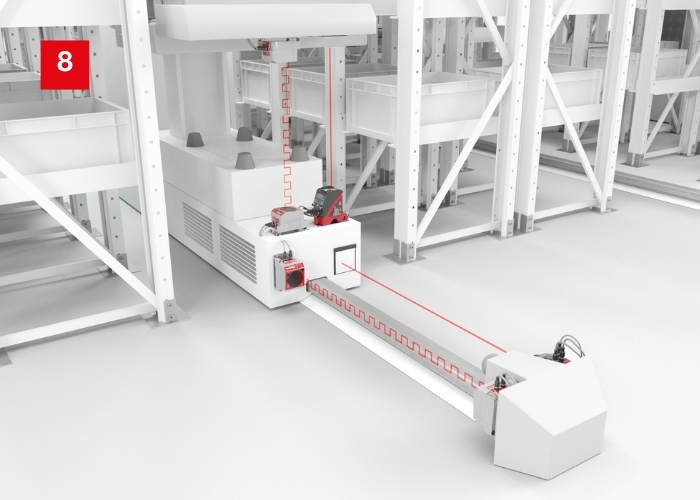
Optical data transmission up to 100 Mbit/s
Requirement:
Data must be transmitted wirelessly from Ethernet-based fieldbuses such as PROFINET, EtherCAT and Ethernet TCP / IP to the stacker crane or the load receptacle. The transmission rate must be designed for data volumes of up to 100 Mbit/s.
Solution:
The DDLS 500 data transmission photoelectric sensor with industrial Ethernet interfaces transmits data at a rate of up to 100 Mbit/s. The alignment laser and the pre-mounted mounting plate make it particularly easy to align the devices, and the integrated web server ensures fast and location-independent remote diagnosis.
Precise positioning and reliable detection
In automated storage and retrieval systems, mechanical stresses resulting from varying loads and environmental conditions must be considered. Alongside precise vehicle positioning, the load receptacle must also be finely positioned to ensure the reliable pick-up and transfer of load carriers.
Reliable detection of load carriers and transfer positions is also essential for automated operation. This allows pick-up and drop-off operations to be monitored and enables subsequent movements to be authorized.
Another important application is the optical transmission of control signals to the moving stacker crane. It offers an alternative to mechanically stressed drag cables and enables reliable communication between the stationary control system and the vehicle.